Hey folks, let’s cut to the chase—if you’ve ever stuck your head near a rooftop solar setup and wondered “what even are those thick black wires doing there,” you’re not alone. As a solar cable supplier, I get so many questions about these humble little cables that power everything from your home’s rooftop panels to the battery bank keeping your lights on after dark. Today, we’re breaking down exactly how these cables work, no stuffy engineering jargon that’ll make your eyes glaze over. Solar Cable
First off, let’s stop treating solar cables like just another piece of wire. Regular extension cords you use for your lawnmower? They’re made for low-voltage, short runs, and they get chewed up by sunlight, rain, and extreme heat all the time. Solar cables? They’re built for the exact harsh environment they live in. That’s the first big difference, and it’s why you can’t grab any old wire for your solar system. Let’s start with the basics of how electrons move here.
Every solar panel works by turning sunlight (photons, if we want to get technical) into direct current (DC) electricity. When photons hit the panel’s silicon cells, they knock electrons loose from their atoms—those loose electrons need a path to flow, otherwise they’re just hanging around, doing nothing. That’s where solar cables come in: they’re that dedicated, tough path for electrons to travel from the panel, through the system, and into your inverter (that box that turns DC into alternating current, AC, which is what your home uses).
Now, let’s get into the layers that make a solar cable actually do its job. Most people only see the outer black jacket, but there’s way more going on under that. First, right where the electrons flow: the conductor. That’s usually tinned copper, not plain copper—why? Tinning is just coating the copper with a thin layer of tin, and it stops corrosion, especially from all the humidity and salt air if you’re near the coast. Plain copper would rust or degrade fast out in the elements, which would mess with electron flow. It’s also stranded, not solid wire—stranded means it’s made of lots of tiny copper wires twisted together, which makes it flexible enough to bend when you’re running it between panels, and it doesn’t snap when temperatures swing wildly. Solid copper would crack in super hot or super cold weather, and we can’t have that.
Next up is the insulation around the conductor. This isn’t your average plastic insulation. Solar cables use cross-linked polyethylene (XLPE) or ethylene propylene rubber (EPR), stuff that’s way more durable than the plastic on your extension cord. Sunlight has that UV radiation that breaks down regular plastic over time—leave a cord outside for a year, and it’ll get brittle and crack. XLPE and EPR resist UV, extreme heat (we’re talking -40°F up to 180°F, no matter where you live), and moisture. That insulation keeps the electrons contained inside the conductor so they don’t leak out—leakage would mean wasted power, and trust me, no one wants to lose even a little of that free solar energy. If the insulation fails, you’ve got electricity where it shouldn’t be, which is a fire hazard too—solar cables have to meet strict safety standards for that.
Then there’s the outer jacket, the part you touch. It’s usually made of thermoplastic elastomer (TPE) or another UV-stabilized material, and it’s thick enough to stand up to whatever mother nature throws at it: hail, snow, rain, even rodent damage. Wait, yeah—rodents love chewing on wires, and a good outer jacket keeps them out too. That’s a big one for folks in rural areas or places with lots of squirrels or mice.
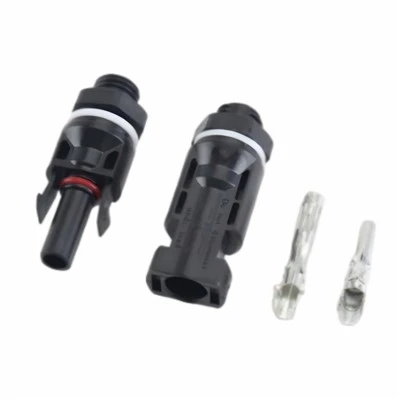
Okay, so electrons flow through the conductor, insulated and jacketed, but how does that actually move power from one panel to the next? Let’s walk through a small rooftop setup to make it real. Suppose you have 20 solar panels on your roof, each one producing about 40 volts DC. Each panel has two tiny connectors on the back—one positive, one negative. The solar cable’s ends are pre-made with MC4 connectors (that’s the industry standard, almost every panel uses ‘em now) so you can just snap them together, no messy splicing on your roof. That’s not just convenient—MC4 connectors are waterproof, dustproof, and vibration-resistant, so they don’t come loose when wind hits your roof.
So, you take the positive cable from Panel 1, plug it into the negative cable from Panel 2, then the positive from 2 into negative from 3, and so on, until you have a whole string of panels connected in series. Wait, series means the voltage adds up—so 20 panels at 40 volts each becomes 800 volts total, which is a nice high voltage. High voltage is good because it means you need thinner cables to carry the same amount of power, which saves on cost and weight. If you tried to run that same power at low voltage, the cables would be way bigger and heavier, and more expensive. That’s why solar systems use higher DC voltage to start with—solar cables are designed to handle that, so they don’t overheat or lose power.
Wait, let’s talk about power loss for a sec. Every time electrons travel through a wire, some energy turns into heat, right? That’s resistance, and it’s normal, but we minimize it with good conductors. That’s why we use tinned copper instead of cheaper aluminum—aluminum is lighter, but it has higher resistance, so you get way more power loss over long runs. For a home rooftop, that’s not a huge deal, but for big commercial solar farms, where cables run hundreds of feet from panels to the inverter, copper is non-negotiable. As a solar cable supplier, we test every batch to make sure resistance is within spec—no cutting corners here, because even 1% more loss adds up to thousands of dollars over the life of the system.
Now, what happens if a cable fails? Like, if a mouse chews through the outer jacket, or the insulation gets damaged from being pinched during installation? If that happens, electrons can leak out, which not only wastes power but can create a short circuit. Short circuits in DC systems are way more dangerous than AC ones, because DC doesn’t naturally turn off when there’s a fault. That’s why all our solar cables are rated for double-insulation, and we label them for outdoor use specifically. We also make sure they’re rated for the right temperature class—if you live in Arizona, you need cables rated for higher heat than someone in Alaska, and we have both options.
Let’s clear up a common myth: solar cables don’t just “carry” power, they’re also designed to last 25+ years. Your solar panels have a 25-year warranty, so the cables can’t be the weak link. That’s why we use materials that resist degradation from UV, ozone, moisture, and thermal cycling—all the stuff that breaks down regular wires in 5-10 years. We test our cables in environmental chambers that simulate 25 years of sun, rain, and temperature swings, to make sure they hold up. Last year, we supplied cables for a 10-megawatt solar farm in Texas, and they’ve already gone through two summers of 110°F heat with zero issues. That’s the kind of reliability we build into every cable we make.
Another thing people don’t think about: installation. Solar cables are flexible, so installers can run them around pipes, over roof vents, through conduits, without having to fight with stiff, rigid wire. The stranded conductor makes that possible, which cuts down on installation time and labor costs. But they’re still tough enough to stand up to being pulled tight or run over by a maintenance truck on a big commercial site.
Wait, what about ground cables? Sometimes people mix up power cables with ground cables, but solar systems need both. Power cables carry the DC electricity from panels to inverter, while ground cables connect all the metal parts of the system (frame, panels, inverters) to the earth, so if there’s a fault, electricity flows safely to the ground instead of through someone who touches the system. We supply both single-core and twin-core solar cables, some with a built-in ground conductor, so you can get exactly what you need for your setup.
Let’s get back to how it all works step by step, to make it super clear: 1) Sun hits solar panel, knocks electrons loose to make DC power. 2) Positive and negative electrons travel through the conductors in solar cables, kept contained by insulation and outer jacket. 3) MC4 connectors link cables between panels to build a series string, or sometimes parallel strings for more power. 4) Cables carry the high-voltage DC to the combiner box, which groups all the strings together. 5) From the combiner box, another set of solar cables runs to the inverter, which turns DC into AC for your home or the grid.
The key thing that makes solar cables different from every other wire out there is that they’re purpose-built for this exact job. No extension cord will do, no electrical wire from your local hardware store—those aren’t rated for outdoor use, UV exposure, or the high DC voltage of solar systems. If you use the wrong wire, you’re looking at power loss, fire risk, and a cable that will need to be replaced in a few years, when your whole solar system should be working for 25+.
As someone who’s been supplying solar cables for years, I can’t stress enough how important it is to get the right cable for your project. Whether you’re a homeowner putting 10 panels on your garage, a small business adding a 50-panel setup, or a developer building a big solar farm, picking the right solar cable isn’t just a small detail—it’s part of what makes your solar system work reliably for decades.

If you’re planning a solar project, or just want to upgrade your current setup with better, more reliable cables, reach out to chat through your needs. We can help you figure out what size, length, and type of cable works best for your space, no jargon, no pressure—just straight talk about what your system needs to run smoothly.
Special Breaker References
- National Electrical Code (NEC) Article 690 for Solar Photovoltaic Systems
- International Electrotechnical Commission (IEC) 60227 and IEC 60245 Standards for Insulated Cables
- Underwriters Laboratories (UL) 4703 Standard for Photovoltaic Cables
- Solar Energy Industries Association (SEIA) 2023 Guide to Solar System Components
Zhejiang Leidun Electric Co., Ltd.
As one of the most experienced solar cable manufacturers and suppliers in China, we also support customized service and OEM service. Please feel free to wholesale high quality solar cable made in China here from our factory. Thank you for your interest in our products.
Address: No.337, Liule Road, Liushi Town, Yueqing City, Wenzhou City, Zhejiang Province, China
E-mail: Sales@zgleidun.com
WebSite: https://www.leidunelectric.com/
