If you’ve ever stood in a warehouse at 2 a.m., watching a team of forklift operators juggle pallets while a smaller, nimble unit weaves between aisles, you’ve likely seen a manual stacker at work. I’m Mia, and I’ve spent the last seven years running the end-to-end operations of a supplier that specializes in manual material handling equipment—specifically, manual stackers. Over those years, I’ve lost count of how many times customers have stopped mid-conversation to ask a question that seems simple on the surface: “What’s the price of a manual stacker?” It’s a question with a thousand answers, and if you’re shopping for one, figuring out that number means peeling back layers that go way beyond the sticker price you see on a listing. Manual Stacker
First, let’s get one thing straight: a manual stacker isn’t a one-size-fits-all tool. It’s a piece of equipment built for specific jobs, so its price is tied directly to what you need it to do. I learned this early on, when a small bakery client came to me asking for a stacker to move 50-pound sacks of flour onto overhead shelves. They’d ordered a basic model online for $800, only to have it crack on the third day when they loaded 60 pounds onto it. That mistake stuck with me. From that point on, I stopped quoting prices without asking three core questions: how much weight do you need to lift, how high do you need to lift it, and what kind of space do you have to work with?
Let’s start with lifting capacity, the biggest driver of price for manual stackers. Most entry-level models on the market today have a capacity of 1,000 kilograms (about 2,200 pounds). These are the workhorses for small shops, retail stockrooms, or light manufacturing lines where you’re moving pallets of clothing, small boxes, or non-heavy bulk goods. A good quality, entry-level 1,000kg manual stacker from our lineup usually retails between $1,200 and $1,800. Why the range? The difference comes down to build quality. Some cheaper import models use thin-gauge steel that bends after a few months, while ours use reinforced grade 50 steel that’s tested to handle 1,100kg consistently, with a safety overload valve that keeps you from overloading the unit by accident. I’ll be honest—you can find a 1,000kg stacker for $800 if you shop around, but we’ve seen too many customers end up paying for repairs or a replacement within a year. That “bargain” isn’t one at all.
If your work requires more power, you’ll move into the 1,500kg to 2,000kg capacity range. These are the stackers you’ll see in distribution centers or medium-sized warehouses moving pallets of bottled water, building materials, or heavy retail inventory. Their price starts at around $2,000 and goes up to $3,500, depending on features. The extra capacity doesn’t just mean a sturdier frame—it means a more robust hydraulic pump, thicker lifting chains, and larger wheels that can roll over uneven warehouse floors without tipping. A lot of our construction supply clients swear by these models because they can lift a full pallet of cinder blocks 10 feet high without straining, something a basic entry-level stacker can’t do safely.
Lifting height is the second big factor that changes the price. A manual stacker’s maximum lift is measured from the ground to the fork’s top when fully extended. Most small businesses only need a lift height of 2.5 meters (about 8 feet), which is enough to load pallets onto standard 8-foot loading docks or store goods on lower shelves. For that height, you can expect to pay the entry-level rates I mentioned earlier. But if you need to lift higher—say, 4 meters (13 feet) or more to access tall warehouse racking or mezzanine levels—the price jumps. Lifting higher means longer lifting masts, heavier-duty seals in the hydraulic system, and stronger guide rails to keep the forks stable as they go up. A stacker with a 4-meter lift height will usually cost between $2,200 and $4,000, while specialty models with extra-high lifts (up to 6 meters, or almost 20 feet) can run $5,000 or more. We recently worked with a regional grocery chain that needed stackers to restock their backroom shelves, some of which were 18 feet high. Those models came with extended masts and reinforced load backrests to keep cases from falling off the forks while they were high up, and each one was just over $4,500.
Beyond capacity and height, features are the next piece of the price puzzle, and they can add or subtract a lot depending on what you actually need. Let’s start with the most common add-ons that don’t break the bank. Fork adjustability is a big one. If you’re moving different sizes of pallets—standard 48×40 inch pallets, smaller half-pallets, or even custom-sized skids—forks that can widen or narrow make a huge difference. A stacker with fixed forks will be a few hundred dollars cheaper than one with adjustable forks, but if you switch between pallet sizes regularly, that extra cost is worth every penny to avoid damaging pallets or having to use two different pieces of equipment. We once had a small furniture store client who needed to move both full-sized pallets of sofas and smaller crates of cushions; adjustable forks meant they used one stacker instead of renting a second tool for the crates, saving them thousands a year.
Next, wheel type. Most basic manual stackers come with polyurethane (PU) wheels, which are quiet, roll smoothly on concrete, and work well indoors. They cost less, too—these models are around $100 to $200 cheaper than models with pneumatic rubber wheels. But if you work on uneven surfaces—dirt floors in a workshop, gravel yards, or loading docks with cracks and potholes—pneumatic wheels are non-negotiable. They absorb shock better, don’t get stuck on uneven ground, and reduce strain on the operator’s arms when moving heavy loads over rough areas. The downside? Pneumatic wheels are more prone to flats, so if you’re using your stacker on a job site with debris, you’ll want to add a puncture-resistant coating to them, which adds another $50 to $100 to the total.
Then there are the premium features that only make sense for certain businesses. Power-assisted lifting is one of these. A standard manual stacker requires you to pump a hydraulic lever dozens of times to lift a heavy load—if you’re lifting 1,500kg to 4 meters high, that’s 50 or more pumps, and it can leave operators sore by the end of a shift. Power-assisted lifting uses a small battery to reduce the effort needed, cutting the number of pumps in half or more. These models start around $3,800, and they’re a game-changer for businesses with high operator turnover, or for teams where operators are moving heavy loads all day. We’ve had clients switch from manual to power-assisted stackers and report a 20% drop in workplace strain injuries, which saves them way more than the cost of the equipment in workers’ comp claims.
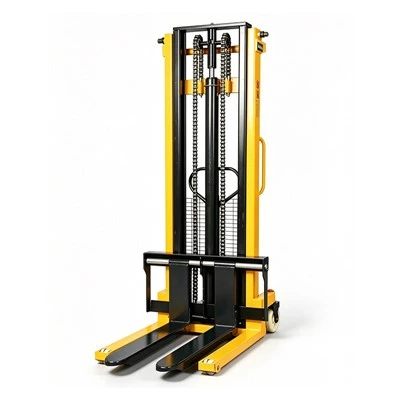
Another premium feature is straddle legs. Basic stackers have legs that stick straight out from the forks, which means you can only use them for pallets that fit between the legs. Straddle stackers have legs that widen at the base, so you can drive them under narrower pallets, or use them in aisles as small as 1.2 meters (4 feet) wide—ideal for small stockrooms or retail backrooms with tight space. A straddle stacker with a 1,500kg capacity and 3-meter lift height costs about $300 to $500 more than a regular model, but for businesses with limited aisle space, that’s an essential upgrade.
Now, let’s talk about the stuff that doesn’t show up on the price tag, but makes a huge difference in the long run. That’s where quality and support come in. Early in my career, I saw a customer buy three $700 stackers in a year because the seals would leak, the frames would bend, and the wheels would fall off within months. When they came to me frustrated, I showed them the warranty on our stackers: two years on parts and labor, five years on the frame. That’s the hidden value. Our stackers are built with materials that don’t corrode even if you use them in damp warehouses or outdoor loading areas, and we have a team of service technicians who can fix a problem on-site within 24 hours, no matter where you’re located. When you compare total cost of ownership over five years, a $1,500 stacker with a five-year lifespan and low maintenance is way cheaper than a $800 stacker that needs replacing every 18 months.
Brand also plays a role, and not just in the way you’d think. I’ve seen generic import brands slash prices to undercut competitors, but most of them don’t meet OSHA safety standards. That’s a big red flag. A stacker that fails a load test isn’t just expensive to replace—it can cause a pallet to fall, damaging goods or injuring an operator. All our manual stackers are tested to meet ISO 9001 and OSHA standards, and we provide full safety certifications with every unit. That peace of mind is worth the extra cost, especially for businesses that have to keep detailed safety records for their teams.
Let’s put this all together with real-world examples to make it concrete. If you own a small e-commerce warehouse with standard 48×40 inch pallets, lifting 1,000kg, and need to lift 2.5 meters high to access standard shelves: a basic, quality stacker with fixed PU wheels will cost $1,300 to $1,500. If you have tight aisles and need adjustable forks, that goes up to $1,500 to $1,700. If you need to lift 3.5 meters high for a small mezzanine, add $200, bringing it to $1,700 to $1,900.
If you’re a construction supply business moving heavy building materials on uneven loading docks, need 1,800kg capacity, a 3-meter lift height, and pneumatic wheels: you’re looking at $2,800 to $3,200. If you need power-assisted lifting to reduce operator strain, that jumps to $3,600 to $4,000.
There’s no such thing as a “one price fits all” when it comes to manual stackers, and that’s why the best way to get an accurate quote is to talk to someone who understands your specific needs. We don’t sell equipment out of a catalog that says “$1,200 for a manual stacker”—we ask questions, assess your workspace, your load requirements, and your team’s needs, then put together a package that works for you.
I’ve been in this business long enough to know that price is only part of the story. A manual stacker is an investment in your team’s safety, your operational efficiency, and your bottom line. Buy something too cheap, and you’ll pay for repairs, replacements, and downtime. Buy something too expensive with features you don’t need, and you’re wasting money that could go to growing your business.
If you’re tired of guessing what a manual stacker should cost, or you’re not sure which features you actually need, reach out to our team. We’ll walk you through every option, share real case studies from businesses similar to yours, and give you a transparent quote with no hidden fees. Whether you need one stacker for a small boutique or 20 for a large distribution center, we’re here to help you find the right tool at a price that makes sense for you. Don’t make the same mistake that early bakery client made—don’t let a low sticker price cost you more in the long run.
Reach Forklift References:
- Occupational Safety and Health Administration. Material Handling Equipment Safety Guidelines. U.S. Department of Labor, 2022.
- International Organization for Standardization. ISO 18886:2019, Lift Trucks – Safety Requirements and Verification. ISO, 2019.
- Material Handling Industry Association. Manual Lift Truck Total Cost of Ownership Report. MHI, 2023.
- National Institute for Occupational Safety and Health. Musculoskeletal Disorders and Manual Material Handling. CDC, 2021.
Huazheng Heavy Industry Machinery Equipment Co., Ltd.
With abundant experience, we are one of the most professional manual stacker manufacturers and suppliers in China. Please feel free to buy high quality manual stacker for sale here from our factory. We also accept customized orders.
Address: Room 423-101, Building C-4, Electronics Valley Technology Center, No.3088 Lekai North Street, Gaokai District, Baoding City, Hebei Province, China
E-mail: sales02@hzheavy.com
WebSite: https://www.hzheavy.com/
