If you’ve ever stood on the floor of a BLDC motor assembly line, you know that even the smallest misstep in component transport can ripple into hours of rework, downtime, or even scrapped parts. As a supplier specializing in turnkey BLDC assembly lines, I’ve spent 12 years troubleshooting this exact pain point for automotive, HVAC, and drone manufacturers—clients who rely on tight, consistent cycle times to hit production targets. Over the years, I’ve seen lines that stalled because someone tried to wheel a stack of stators on a flimsy pallet across the shop floor, and others that ran like clockwork because their component transport was built into the line’s DNA. Let’s break down what works, what doesn’t, and how to build a transport system that fits your line, not the other way around. BLDC Motor Assembly Line
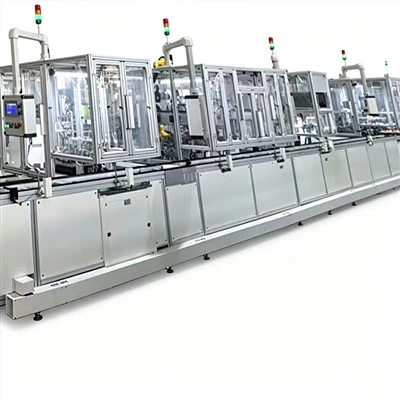
First, let’s ground this in the unique demands of BLDC components, because generic material handling advice rarely applies here. BLDC motors rely on precision parts: stators with tight winding tolerances, magnets that are brittle and prone to chipping, rotors with balanced shaft alignments, and encoders that are sensitive to vibration. Drop a stator from 6 inches, and you can bend its laminations enough to throw off winding efficiency. Jostle a raw neodymium magnet against a metal tool, and it might demagnetize a fraction—enough to make the final motor fail torque tests. Even the smallest bolts, washers, and connector pins are not trivial: mix up fastener sizes for the stator housing, and you’ll waste 10 minutes per motor taking them apart. So any transport method has to prioritize part integrity first, then speed, then alignment with your line’s workflow.
The most common mistake I see new line designers make is treating “component transport” as an afterthought. They map out workstations, order robots and winding machines, and then at the last minute grab standard plastic bins from a big-box industrial supplier. That’s how you get bottlenecks. Instead, transport should be integrated into every station’s layout. Let’s start with the two core transport models used in modern BLDC lines: unit-load transport and part-specific carousel transport, and when to choose each.
Unit-load transport is the workhorse for high-volume, continuous BLDC lines—think 500+ motors per shift, where every workstation is linked by a automated or semi-automated conveyor system. In this model, components (or subassemblies, like a stator with pre-wound coils) are loaded into standardized, custom-molded pallets that slot directly into each station. For stators, we design pallets with individual pockets, each lined with closed-cell foam cut to match the stator’s outer diameter; this keeps stators from rubbing against each other, absorbs shock from the conveyor, and lets operators pull one stator at a time without disturbing the rest. For magnets, we use pallets with rubberized, slot-style holders that prevent magnets from shifting, and we add a thin plastic barrier between each row to avoid accidental magnetic contact. The key here is that each pallet is sized to hold exactly the number of parts needed for a 15-minute production run—no overloading, no half-empty pallets cluttering the line.
A client in the commercial HVAC space switched to this system three years ago, going from loose bins on a manual conveyor to custom unit-load pallets. They reported a 72% drop in stator damage and a 18% reduction in line downtime from part shortages, because the pallets only deliver as many parts as the next station can process. The downside? Unit-load systems are less flexible if you’re running multiple BLDC variants—say, a 1kW motor for fans and a 5kW motor for blowers, which have different stator diameters. For low-mix, high-volume lines, this is non-negotiable, but for lines with 5+ SKUs, carousel transport is a better fit.
Part-specific carousel transport is the go-to for mixed-variety BLDC lines, especially those building motors for drones, electric bikes, or small appliances, where 2–3 different stator sizes or magnet configurations might run on the same line. Instead of a single conveyor, each workstation has a small, motorized carousel that stores 4–6 component trays, each calibrated for a specific part. For example, a rotor station might have three trays: one for 100mm rotors, one for 120mm, and a spare for new part changeovers. Operators select the correct tray via a touchscreen on the station’s control panel, eliminating the risk of grabbing the wrong part. We add a light cue on the carousel, so when a tray is ready, a green light illuminates, and operators can pull it without searching. This cuts part mix-ups by 90% for lines with multiple SKUs, per data from a drone motor client I worked with last year.
But no transport system is set-it-and-forget-it. The biggest pitfalls come from how you handle intermediate components between stations, especially when moving parts between manual and automated workcells. For example, a stator winding station might be manual, where an operator loads bare laminations, and the next station is a robotic wire inserter. If you send loose stators in a bin, the robotic gripper can’t consistently pick a single lamination—they might stick together from static, or the bin’s edges might catch the gripper. That’s why we add a “pick-to-order” buffer between these stations: a small, motorized table that holds 8–10 stators, presented in a uniform, upright position. The winding operator loads stators one at a time onto the buffer, and the robot picks directly from there, no fumbling. This tiny addition reduced that client’s robot cycle time by 12% because the gripper no longer had to navigate a messy bin.
Another often-overlooked detail is transport frequency and timing. You don’t want a conveyor delivering stators every minute if the winding station only needs 10 per hour, and you don’t want an operator walking across the line to grab a rotor every two minutes if that cuts into their assembly time. The sweet spot, based on my team’s analysis of 20+ BLDC lines, is a “just-in-time” transport window: components are delivered to a station’s buffer exactly when the station is ready to process them. For manual assembly stations, that means a cycle time of every 2–3 minutes for small parts, so operators never run out but also don’t have to store piles of parts at their workbench. For automated stations, it’s a signal-based trigger: when a robot’s buffer has 2 parts left, the transport system sends a new batch.
We also address two specific BLDC part challenges with custom transport solutions: magnets and encoders. Magnets are the most delicate, and their handling is a common source of line issues. Standard plastic bins can’t prevent magnets from snapping together or scratching, so we use magnetic transport trays lined with non-metallic, low-friction material—aluminum or polyethylene, not steel—so magnets stay in place without clinging to the tray. For lines that handle bonded magnets (less brittle than neodymium, but prone to adhesive damage), we add soft foam inserts that hold each magnet’s shape. Encoders, on the other hand, are sensitive to dust and vibration. When moving encoders between a storage area and the final assembly station, we use sealed, dust-proof carriers that lock in place, and we avoid conveyor routes that run near high-vibration equipment like impact wrenches. I once worked with a robotics startup that was scrapping 15% of encoders because they were shaken during transport; switching to sealed carriers cut that scrap rate to less than 1% in 3 months.
Now, for manual lines—if you’re a smaller manufacturer that doesn’t have budget for automated conveyors—transport is a whole different ballgame. For these lines, we recommend mobile, modular carts, not hand trucks. Each cart is divided into labeled, color-coded bins for each component: stators, rotors, magnets, fasteners. We add a weight limit of 50 pounds per cart, so operators don’t overexert themselves, and locking casters that let carts stay perfectly aligned with workstation openings. A client making small BLDC motors for power tools switched from using unlabeled bins and hand trucks to these modular carts, and they reported a 25% reduction in operator fatigue and a 10% drop in part damage, because every bin had a dedicated spot. We also add a “return bin” on each cart for scrap parts, so operators don’t have to walk to a central scrap station mid-shift.
The last piece of the puzzle is tracking. Transport systems shouldn’t just move parts—they should capture data to keep your line running smoothly. We integrate RFID tags onto each pallet or component tray, so every time a batch of stators is delivered to a station, the line’s software logs it, tracking how long parts spend in transport, if any batches are delayed, and where damage occurs. This data lets you spot patterns fast: if stators are getting damaged on the conveyor between stations 3 and 4, you can adjust the foam lining or slow the conveyor speed. For example, a HVAC client noticed that 10% of stators were failing at the final test station; looking at the RFID data, we found they were jostled too hard on the conveyor’s curve. We added a small guardrail and reduced the curve’s angle, and that failure rate dropped to 1%.
I’ll be honest: there’s no one-size-fits-all transport system. What works for a 1,000-unit-per-day automotive line won’t work for a 50-unit-per-day custom drone line. But the core principles stay the same: design transport around the specific needs of BLDC parts, integrate it into your workstation layout instead of tacking it on, align transport frequency with your cycle times, and use data to tweak it over time.
If you’re building a new BLDC assembly line or looking to upgrade your current transport system, we’ve helped clients across industries implement solutions that cut downtime, reduce part scrap, and keep lines running at peak efficiency. We don’t sell generic bins or off-the-shelf conveyors—we build transport systems tailored to your part sizes, your SKU mix, and your production targets.

If you’re ready to talk through your specific challenges, we’d love to connect. Whether you’re dealing with stator damage, part mix-ups, or line bottlenecks from poor component transport, we can walk through what’s worked for other BLDC manufacturers and help you design a system that fits your operation.
Stator Assembly Line References
- Industrial Assessment Center, 2022. "Material Handling Optimization for Small Electric Motor Assembly Lines." Proceedings of the Society of Manufacturing Engineers.
- BLDC Motor Manufacturing Best Practices Guide, 2023. International Society of Automotive Engineers (SAE) Electric Motor Division.
- Material Handling and Logistics Journal, 2021. "Delivering Just-In-Time Components to Automated Assembly Workcells." Vol. 62, No. 4.
Juli Aoxuan Technology (Zhejiang) Co., Ltd.
Juli Aoxuan Technology (Zhejiang) Co., Ltd. is one of the most professional BLDC motor assembly line manufacturers and suppliers in China. With abundant experience, we warmly welcome you to buy durable BLDC motor assembly line made in China here from our factory. If you have any enquiry about cooperation, please feel free to email us.
Address: No.28, Guangming Middle Road, Haiyou Street, Sanmen County, Taizhou City, Zhejiang Province, China
E-mail: sales05@juli-china.com
WebSite: https://www.juli-winding.com/
