Hey there! I’m a supplier of 5 Axis CNC Machining services. Over the years, I’ve had countless conversations with customers who are trying to figure out whether 5 Axis CNC Machining or laser cutting is the right choice for their projects. So, I thought it’d be cool to break down the differences between these two methods in a blog. 5 Axis CNC Machining
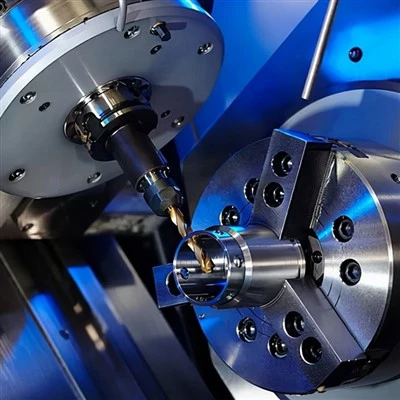
Let’s start with the basics of 5 Axis CNC Machining. In simple terms, 5 Axis CNC Machining is a manufacturing process that uses computer numerical control (CNC) to move a cutting tool along five different axes simultaneously. This allows for a high level of precision and the ability to create complex geometries that would be nearly impossible or extremely time – consuming with traditional machining methods.
The five axes typically refer to three linear axes (X, Y, and Z) and two rotational axes. The rotational axes can tilt and swivel the cutting tool or the workpiece, enabling the machine to access multiple sides of the part without re – clamping. This is a huge advantage when it comes to making parts with undercuts, complex curves, and 3D – shaped features.
5 Axis CNC machines are pretty versatile. They can work with a wide range of materials, including metals like aluminum, steel, and titanium, as well as plastics, wood, and composites. They’re used in various industries too, such as aerospace, automotive, medical, and defense. For example, in the aerospace industry, 5 Axis CNC Machining is used to make turbine blades, which have very complex aerodynamic shapes.
Now, let’s talk about laser cutting. Laser cutting is a thermal separation process that uses a high – power laser beam to melt, burn, or vaporize the material. The laser beam is focused on the workpiece, and as it moves along a pre – programmed path, it cuts through the material.
One of the main advantages of laser cutting is its speed. It can cut through materials very quickly, especially thin sheets of metal or plastic. Laser cutting is also great for making precise cuts. The laser beam is very narrow, which means it can create fine details and tight tolerances.
Another benefit of laser cutting is its flexibility. You can use it to cut a variety of shapes, from simple straight lines to complex patterns. And since it’s a non – contact process, there’s no physical force applied to the workpiece, which reduces the risk of deformation.
However, laser cutting has its limitations. It’s primarily suited for thin materials. When you try to cut thicker materials, the laser may not be able to penetrate completely, or the cut quality may decrease. Also, laser cutting is mainly used for 2D cuts, although some advanced systems can do limited 3D cutting. But for highly complex 3D geometries, it falls short compared to 5 Axis CNC Machining.
Let’s dig deeper into the differences between the two.
Precision and Complexity
5 Axis CNC Machining takes the cake when it comes to precision for complex 3D parts. With the ability to move along five axes, it can create parts with extremely tight tolerances and complex shapes. For example, if you need a part with intricate internal channels or a curved surface with a very specific profile, 5 Axis CNC Machining is the way to go.
Laser cutting, on the other hand, is very precise for 2D cuts. It can achieve high – quality cuts with fine details, but when it comes to creating fully – fledged 3D objects or parts with complex internal structures, it can’t compete with 5 Axis CNC Machining.
Material Compatibility
As I mentioned earlier, 5 Axis CNC Machining can work with a wide variety of materials. Whether you’re dealing with a hard metal like stainless steel or a soft plastic like polycarbonate, a 5 Axis CNC machine can handle it. It can also machine composites, which are becoming increasingly popular in industries like aerospace and automotive.
Laser cutting has a more limited material range. It works well with metals like mild steel, aluminum, and brass, as well as some plastics. But some materials, like certain types of glass and rubber, are difficult or impossible to cut with a laser due to their properties.
Speed
Laser cutting is generally faster for cutting thin materials, especially when it comes to simple 2D shapes. The laser can move quickly across the material, making the cut in a short amount of time. However, when it comes to machining complex 3D parts, 5 Axis CNC Machining may take longer. The cutting process is more intricate, and there are multiple axes of movement to control. But for high – quality, complex 3D parts, the extra time spent on 5 Axis CNC Machining is often worth it.
Cost
The cost factor depends on several things. For simple 2D cuts on thin materials, laser cutting is usually more cost – effective. It requires less setup time and can produce parts quickly. However, for complex 3D parts, the cost of 5 Axis CNC Machining may be justified by the quality and complexity of the finished product. The initial setup cost for 5 Axis CNC Machining can be high, but for large – scale production of complex parts, the per – part cost can become quite reasonable.
Application Areas
5 Axis CNC Machining is widely used in industries where precision and complex geometries are crucial. In the aerospace industry, it’s used for making engine components, fuselage parts, and landing gear components. In the medical field, it’s used to produce surgical instruments, implants, and dental prosthetics.
Laser cutting is commonly used in sheet metal fabrication, signage production, and the production of electronic components. For example, it’s used to cut the metal chassis for computers and smartphones.
So, how do you decide which method is right for your project? It really depends on your specific requirements. If you need a complex 3D part with high precision and are working with a wide range of materials, 5 Axis CNC Machining is probably the best option. On the other hand, if you need a quick, precise 2D cut on a thin material, laser cutting might be more suitable.
As a supplier of 5 Axis CNC Machining services, I can offer you the expertise and capabilities to create high – quality, complex parts. Our team of experienced engineers and operators know how to get the most out of our 5 Axis CNC machines. We can work with you from the design phase to the final production, ensuring that your part meets all your specifications.

If you’re still not sure which method is right for your project, or if you’d like to discuss your specific requirements, don’t hesitate to reach out. We’re more than happy to have a chat and help you make the best decision for your business.
Die Casting Service Whether you’re in the aerospace, automotive, medical, or any other industry, we’re here to provide you with top – notch 5 Axis CNC Machining services. So, get in touch and let’s start working on your next project together!
References
- Boothroyd, G., Dewhurst, P., & Knight, W. (2011). Product Design for Manufacture and Assembly. CRC Press.
- Wohlers, T., & Gornet, P. (2017). Wohlers Report 2017: Additive Manufacturing and 3D Printing State of the Industry. Wohlers Associates.
- Kalpakjian, S., & Schmid, S. R. (2013). Manufacturing Engineering and Technology. Pearson.
Shenzhen Shunhaoda Technology Co., Ltd.
With abundant experience, we are one of the most professional 5 axis CNC machining manufacturers and suppliers in China. If you’re going to buy bulk high quality 5 axis CNC machining made in China, welcome to get free sample from our factory. Also, custom service is available.
Address: 902, Building A3, Tianrui Industrial Park, No. 35 Fuyuan 1st Road, Zhancheng Community, Fuhai Street, Bao’an District, Shenzhen
E-mail: sales@shdindustry.com
WebSite: https://www.shd-industry.com/
