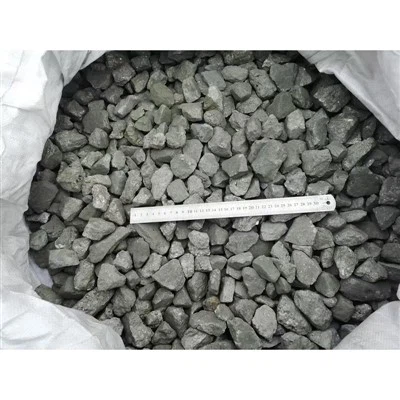
Hey there! I’m a supplier of Pyrite-types Of Ores, and today I wanna dive into the cool applications of pyrite in the chemical industry. Pyrite, also known as "fool’s gold" ’cause it looks kinda like gold but ain’t, is way more useful than you might think. Pyrite-types Of Ores
Making Sulfuric Acid
One of the biggest deals when it comes to pyrite in the chemical industry is making sulfuric acid. Sulfuric acid is like the workhorse of the chemical world. You can find it in fertilizers, detergents, and a whole bunch of other products.
Here’s how it works. First, we heat up pyrite in a furnace. When pyrite (FeS₂) gets heated, it reacts with oxygen in the air. The equation’s a bit of a mouthful: 4FeS₂ + 11O₂ → 2Fe₂O₃ + 8SO₂. This reaction gives us sulfur dioxide gas (SO₂).
Next, we turn that sulfur dioxide into sulfur trioxide (SO₃). We use a process called the contact process. In this process, we pass the sulfur dioxide over a catalyst, usually vanadium(V) oxide, which speeds up the reaction 2SO₂ + O₂ ⇌ 2SO₃. It’s a reversible reaction, but the conditions are set just right to get a good amount of sulfur trioxide.
Finally, we dissolve the sulfur trioxide in concentrated sulfuric acid to make oleum, and then we dilute the oleum with water to get the good ol’ sulfuric acid SO₃ + H₂SO₄ → H₂S₂O₇ (oleum), H₂S₂O₇ + H₂O → 2H₂SO₄.
This whole process is super important ’cause sulfuric acid is used in so many things. In the fertilizer industry, it’s used to make phosphate fertilizers. It breaks down phosphate rock so plants can use the phosphorus. And in the detergent industry, it helps in the production of surfactants, which are the things that make detergents clean.
Metal Extraction
Pyrite also plays a part in getting other metals out of their ores. In the case of copper extraction, pyrite is often found along with copper ores. When we smelt these ores, pyrite can act as a reducing agent.
During the smelting process, the oxygen in the ore needs to be removed. Pyrite can react with some of the oxygen in the ore. For example, if there are copper oxides in the ore, the iron in pyrite can react with the oxygen from the copper oxide and turn it into copper metal.
Another metal where pyrite is useful is gold. Sometimes, gold is trapped inside pyrite grains. To get the gold out, we use a process called roasting. Roasting the pyrite-containing ore at high temperatures breaks down the pyrite structure and releases the gold. After that, we can use other methods like cyanidation to extract the gold.
Pigment Production
You know those bright yellow and orange pigments you see in paints and plastics? Well, pyrite can be involved in making some of them.
We can take pyrite and convert it into iron compounds. One of the common compounds is iron oxide. We can roast pyrite to get iron oxide. The iron oxide can come in different shades, from yellow (goethite) to red (hematite).
These iron oxide pigments are super popular ’cause they’re stable, non-toxic, and have good coloring properties. They’re used in all sorts of things, like house paints to give your walls that nice warm color or in plastic products to add a splash of color.
Water Treatment
Pyrite can also be used in water treatment. It can help in getting rid of some pollutants in water. For example, pyrite can react with certain heavy metals in water.
When pyrite is in contact with water containing heavy metals like lead or mercury, it can form insoluble metal sulfides. These metal sulfides then settle out of the water, removing the heavy metals from the water supply.
Also, pyrite can act as a reducing agent in water treatment. It can reduce oxidized forms of pollutants, making them less harmful. For example, it can reduce hexavalent chromium, which is a toxic form of chromium, to trivalent chromium, which is much less toxic.
Battery Technology
There’s some exciting research going on about using pyrite in battery technology. Batteries are a big deal these days, with all the electric cars and portable electronics we use.
Pyrite has the potential to be used as an electrode material in batteries. It has a high theoretical capacity, which means it could store a lot of energy. Scientists are working on ways to make pyrite more stable in battery environments so it can be used effectively.
If we can figure out how to use pyrite in batteries, it could be a game-changer. Pyrite is relatively abundant and cheap compared to some of the other materials currently used in batteries.
Conclusion

As you can see, pyrite is one versatile mineral in the chemical industry. From making sulfuric acid to helping in metal extraction, pigment production, water treatment, and even having potential in battery technology, it’s got a lot to offer.
Inorganic Chemicals- Pyrite-related Products If you’re in the chemical industry and looking for a reliable source of Pyrite-types Of Ores, I’m here for you. Whether you need it for large-scale industrial processes or for some research projects, I can supply high-quality pyrite ores. Just reach out, and we can start discussing your needs.
References
- Kirk-Othmer Encyclopedia of Chemical Technology
- Ullmann’s Encyclopedia of Industrial Chemistry
- Journal of Chemical Engineering
- Mineral Processing and Extractive Metallurgy Review
Yunfu Fuliu Mineral Materials Co., Ltd.
We are one of the most reliable pyrite-types of ores suppliers in China, specialized in providing high quality customized products. Welcome to wholesale bulk pyrite-types of ores in stock here from our factory. If you have any enquiry about free sample, please feel free to email us.
Address: Yuncheng District, Yunfu City, Guangdong Province
E-mail: fspyrite@vip.126.com
WebSite: https://www.fuliupyrite.com/
